

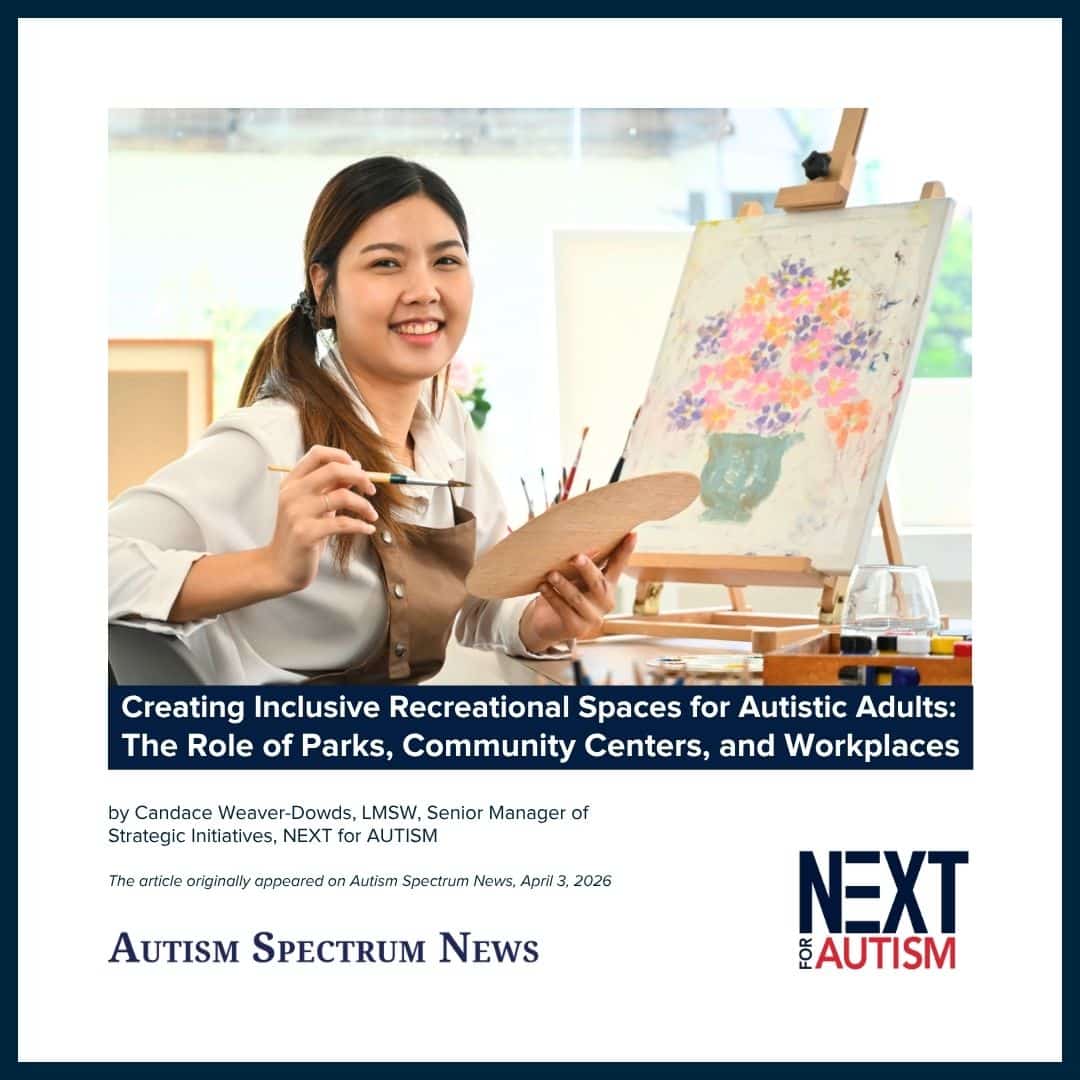
Article by Candace Weaver-Dowds, LMSW, Senior Manager of Strategic Initiatives, NEXT for AUTISM
The article originally appeared on Autism Spectrum News, April 3, 2026
____
In theory, the community center gym was accessible. The ramps were well maintained, automatic doors readily available, and the hours of operation were clearly posted. However, when Jessie arrived after work, the fluorescent lights were glaring, the music was blaring, and every machine was occupied. After a full workday navigating back-to-back meetings, inundation of sensory stimuli, and working through social nuance, the gym’s environment felt overwhelming. They left without exercising, not due to lack of motivation, but because the space required more regulation than Jessie had left to give. Unfortunately, Jessie’s experience mirrors that on many autistic adults.
Inclusive or equitable recreation is often focused on activities for children. Accessibility often focuses on adaptive playgrounds, sensory-friendly story times at libraries, and even youth sports leagues. While these are all needed, autistic adults experience some of the highest rates of social isolation, underemployment, and community exclusion. When recreation is not intentionally designed for adults, isolation deepens. Neuroinclusive recreational options are not a luxury; they are a pathway to belonging.
As autistic adults age, they frequently report a loss of structured social opportunism after school-based services end; environments can feel overstimulating or unpredictable, and there seems to be limited spaces designed with adult sensory needs in mind. The Centers for Disease Control and Prevention identifies physical activity and social connection as critical determinants of long-term health. Having options for recreation is necessary for reducing feelings of isolation, supporting regulation, and strengthening community ties. But Access alone is insufficient. There are simple things municipalities can do to design and offer opportunities for connection and belonging.
City parks and community centers are often assumed to be naturally inclusive, yet without intentional design they can unintentionally exclude autistic adults. Open air and green space can be regulating, but equitable access depends on predictable navigation, sensory-aware environments, adult-focused programming, and fair scheduling. Parks become more usable when they incorporate clear and consistent trail markers, posted maps or easy-to-navigate apps, and clearly identified rest areas, because predictability reduces anxiety and increases independence. Sensory-regulating features such as quiet areas away from playgrounds and sports fields, shaded seating, and low-traffic walking routes help create environments that feel usable rather than overwhelming. Availability of these simple accommodations not only benefit autistic adults but also older adults, individuals with mental health disabilities, or even trauma survivors. Adult-focused programming, including guided nature walks, photography or birdwatching groups, structured outdoor yoga, conservation initiatives, and community gardening, all provide interest-based entry points that reduce reliance on unstructured social interaction.
Similarly, community centers offer valuable structure for connection and wellness but can quickly become overstimulating due to bright lighting, loud music, or crowded fitness areas. Organized, interest-driven programming such as art studios, technology labs, fitness classes, book or gaming clubs, and skill-building workshops lowers social ambiguity. Providing a “Know Before You Go” guide, offering pre-event walkthroughs, clearly identified noise levels, and defined start and end times increase comfort and willingness to participate. While many facilities offer sensory-friendly hours, timing is the key. If low-stimulation access is only available during off-peak or mid-day periods, working adults or those reliant on others for transportation can be excluded. Equitable practice requires evening and weekend options, rotating inclusive time blocks, reducing baseline overstimulation where possible, and providing quiet spaces for regulation. Inclusion cannot require choosing between employment and access.
Community centers and park systems can also intentionally recruit and compensate autistic adults to design, teach, and lead interest-based programming, ensuring that activities are grounded in lived experience and reflect authentic community interests rather than assumptions. Respecting adult autonomy is equally essential. Staff should speak directly to adults, avoid infantilizing language, assume competence, and offer choices.
The true measure of an inclusive community is not whether autistic adults can use its spaces, but whether those spaces were designed with them in mind from the beginning. Recreation is not optional in adulthood. It is where health, employment, and belonging intersect.
#



Leave a Reply